Departments & supervisors
Two structural settings that shape how the firm's compliance record is organised: departments (for grouping and reporting) and supervisors (for the Standard's supervision requirement). They're related but do different jobs.
Departments
Firm → Departments lets you group your team along the lines your practice actually works.
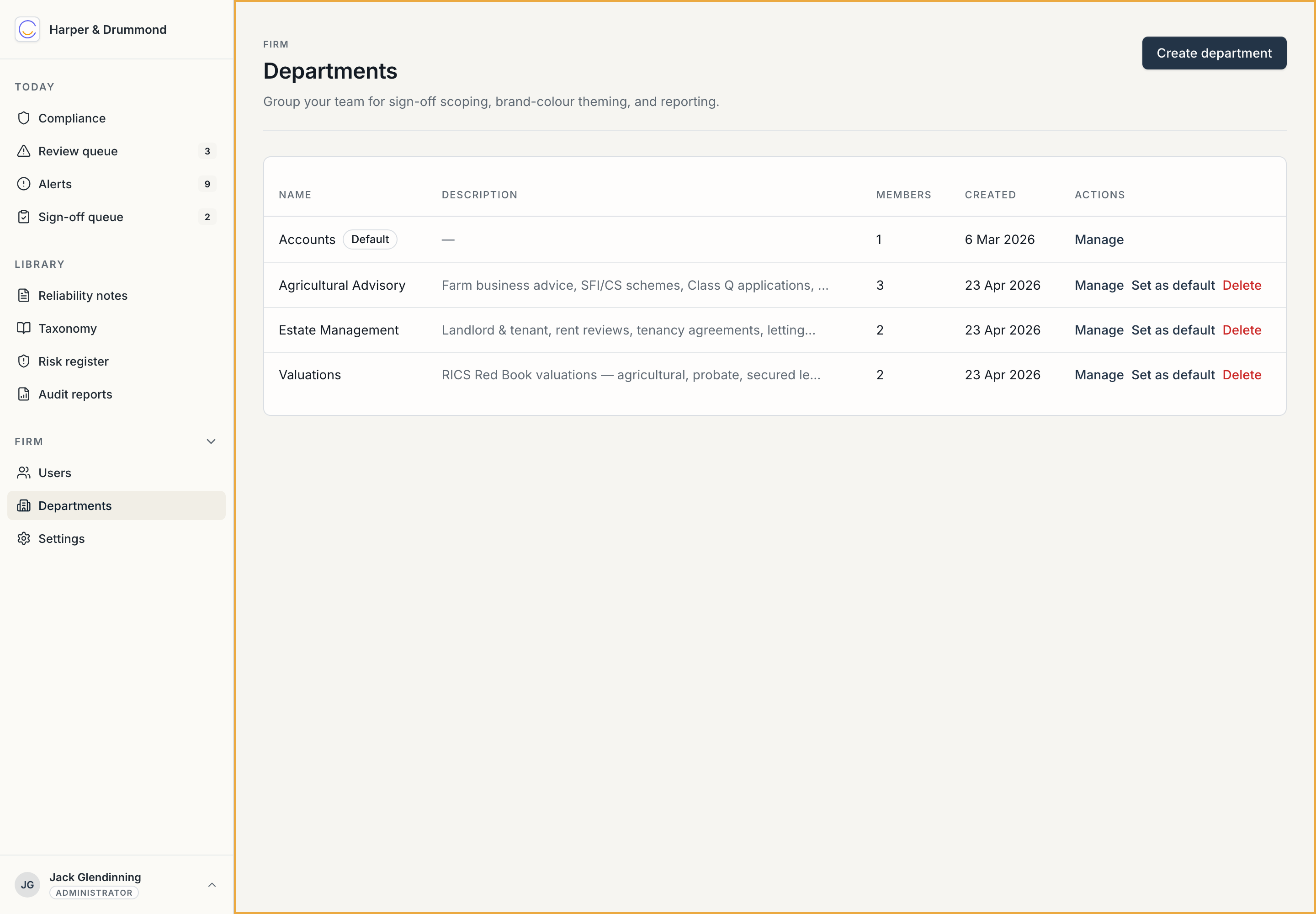
Each department has a name, a short description, a member count, and a created date. One is the default — anyone not explicitly placed lands there. The example firm has Accounts (the default), Agricultural Advisory, Estate Management, and Valuations, each described in a line so the purpose is obvious.
Departments are used for:
- Reporting — slicing the dashboard and audit reports by part of the practice.
- Sign-off scoping and theming — keeping reporting and any brand-colour theming organised by division.
They're optional. A small firm can run everything in the default department and never think about it. Use Create department to add one, Manage to edit membership, and Set as default to change which one catches unplaced people. Deleting a department is available but rarely needed — reassign its members first.
Departments are labels, not walls
A department is for organising and reporting. It is not a security boundary — visibility is governed by the supervisor relationship and role, not by which department someone is in. See Roles & who sees what.
Supervisors
This is the one that matters for the RICS Standard. The Standard requires that a material AI-assisted output be prepared by, or under the supervision of, a named qualified surveyor. Chronity meets that by reading one field on each user: their supervisor.
You set a person's supervisor on their Users detail page (see Your team, seats & billing). The effect is significant:
- A supervised surveyor's Track 1 reliability notes name their supervising qualified surveyor as the responsible professional — automatically, on every formal piece of work.
- The supervisor sees their supervised people's records on the dashboard, in reliability notes, in alerts, and in the daily digest. Everyone else sees only their own; admins see everything. (Full rules: Roles & who sees what.)
So in the example firm: Tom Ashford is supervised by James Harper MRICS — Tom's formal valuation work is documented under James's name, and James sees Tom's activity. Sophie Keane is supervised by Catherine Drummond the same way.
Getting it right
A few rules Chronity enforces, so you don't create an impossible structure:
- A supervisor must be someone with professional registration — you can't have an unqualified person supervising formal work.
- No supervision loops (A supervises B supervises A), no supervising yourself, no cross-firm supervision.
The practical advice: every unqualified or trainee fee-earner should have a supervisor, and that supervisor should be the qualified surveyor who genuinely takes responsibility for their work. This single field is how the firm demonstrates the Standard's supervision requirement — treat it as the compliance decision it is, not an org-chart nicety.
Next: The Compliance dashboard.