Reviewing alerts
Alerts are Chronity's exception channel — the small number of things that, out of everything the firm does with AI, are worth a qualified person actually looking at. As AI Lead you're a recipient of every alert, and you own the firm's alert rules.
The firm-wide view is Today → Alerts.
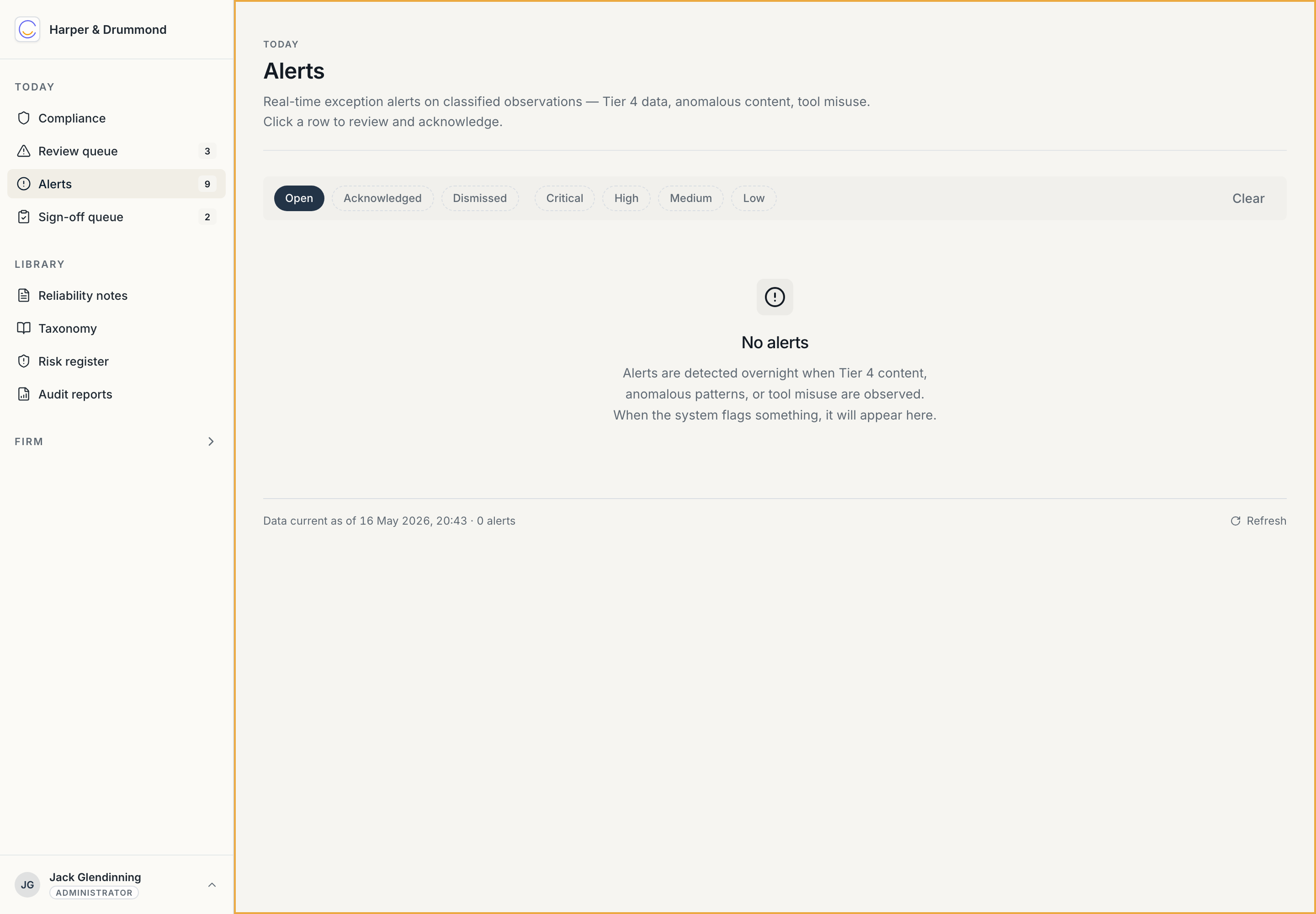
The screenshot shows the normal state: nothing flagged. That's the system working — alerts are exceptions, not routine. Open / Acknowledged / Dismissed tabs; filters for severity (Critical / High / Medium / Low). Each alert, when there is one, opens to show what fired, the observation behind it, and the context.
What the rules detect
The detection rules look for the things the Standard would want a firm to notice:
- Restricted (Tier 4) data appearing in an unapproved tool or context.
- Anomalous content — patterns consistent with a hallucination or a confident error in AI-assisted output.
- Tool misuse — a tool used well outside its intended purpose.
- Opt-out breaches — AI work touching a client who has opted out.
- Anomalous volume — an individual's AI use spiking in a way that warrants a look.
Each alert is routed to the relevant supervisor and to you as AI Lead, so it reaches the people who can judge it, not a shared inbox nobody owns.
Your two jobs here
1. Approve the rule set. The detection rules ship as proposed. They become active for your firm when you accept them. Read them as a set, decide they fit your practice, and turn them on. This is a genuine professional decision — you're defining what your firm considers an exception worth flagging — not a checkbox.
2. Triage what fires. When an alert arrives:
- Open it, read what was flagged, look at the underlying work.
- If it's a false positive — the rule was cautious, which they're tuned to be — acknowledge it with a short note. The acknowledgement is the audit record that a qualified person saw it and judged it.
- If it's real — restricted data really did go somewhere it shouldn't, an opt-out really was breached — acknowledge it, make sure the underlying issue is fixed, and consider whether the taxonomy or a global instruction needs changing so it doesn't recur. A real alert is usually a prompt to adjust the system, not just to tell someone off.
Calibration over time
Early on, expect some over-cautious flags — the rules start deliberately sensitive. Each acknowledgement with a reason is calibration data. After the first month of real activity the picture of what your firm should be alerted on becomes clear, and the rules can be tuned. Treat the first quarter as a settling-in period, not a finished state.
Next: Quarterly dip-sampling.