Track 1 sign-off
This is the heart of the Standard's requirement: a written reliability decision for every material AI-assisted output, by or under the supervision of a named qualified surveyor. Chronity's answer is the auto-drafted reliability file note, and the passive model around it. As AI Lead, you own the firm's posture on this.
Find the firm-wide view at Library → Reliability notes.
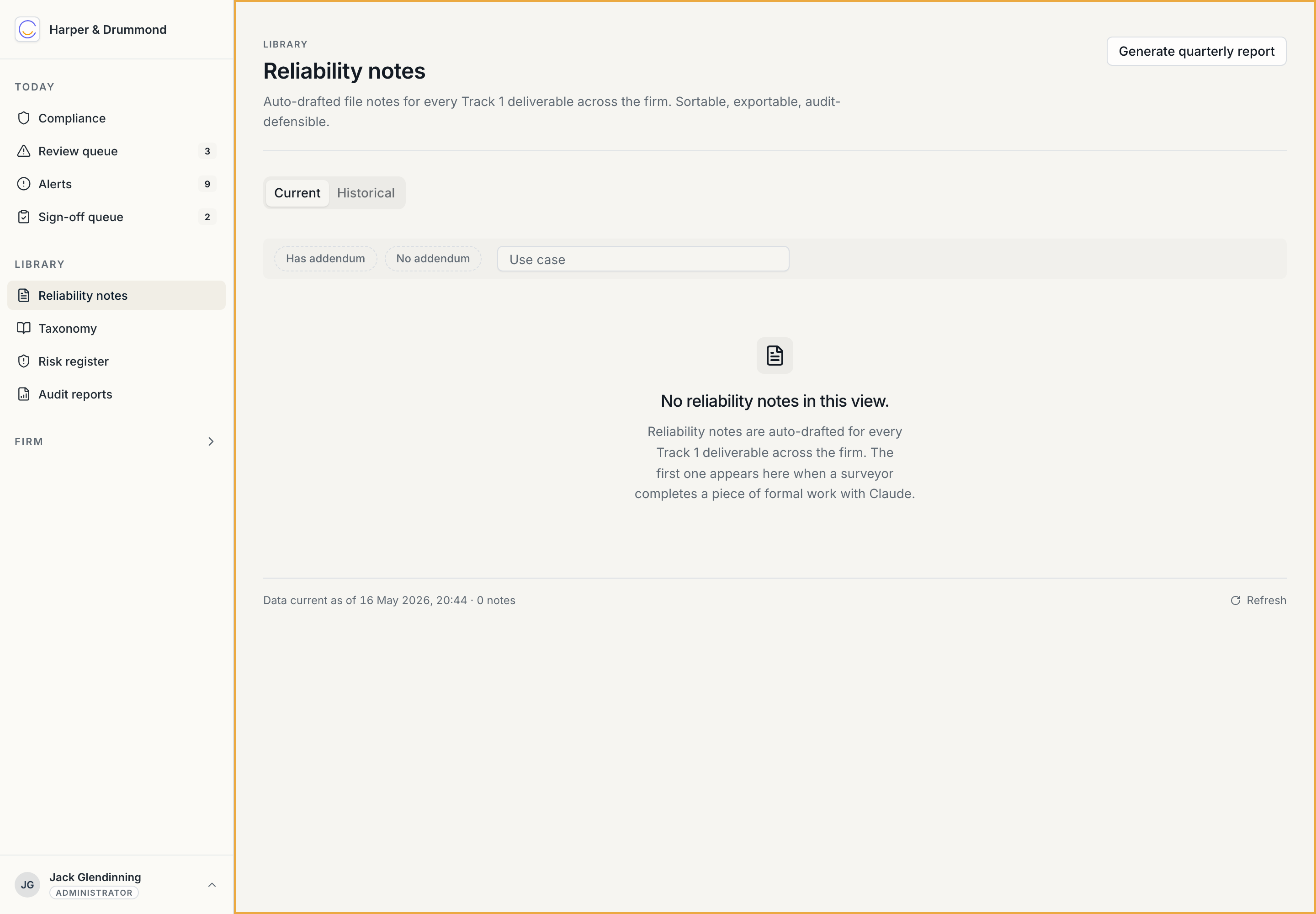
The screenshot is the empty state — what the page shows before any Track 1 work exists, or before notes are surfaced to your scope. When the firm is working, each row is one note: its date, the matched use case, the named surveyor, and status. Current holds the live working set; Historical holds older notes and the 90-day archive. There's a Generate quarterly report action for pulling the period summary (see Audit reports).
The passive model — read this carefully
Under Chronity, the act of a surveyor sending work out under their own name is the professional sign-off. There is deliberately no "approve" button a partner must press for every output — that's the queue-nobody-fills-in that the Standard's critics worry about, and Chronity is built specifically to avoid it.
Instead, for every Track 1 observation, Chronity auto-drafts a reliability note overnight. A note looks roughly like this:
Reliability decision
Use case: document drafting (deliverable) (v1) — Track: 1 · confidential
AI assistance was used to support the drafting of the formal deliverable described in the observation summary. I have reviewed the AI-assisted output against the underlying source material and my own professional judgement. The output has been edited where necessary before release. I, Catherine Drummond MRICS, take professional responsibility for the advice and content of the final deliverable.
Supervisor review: (self-supervising — qualified reviewer).
Where the work was done by a supervised surveyor, the note names their supervising qualified surveyor instead — so the Standard's "by or under the supervision of" wording is satisfied in the document itself. The note references the use case and quotes the standing reliability analysis you signed into the taxonomy — which is why getting the taxonomy right matters so much: it is the reliability reasoning, applied automatically and consistently.
Your oversight, not your bottleneck
The notes draft themselves; your job is informed oversight, not per-output approval:
- Spot-read. Open notes for material matters and sanity-check that the standing analysis the taxonomy applied is the right reasoning for that work. If it isn't, the fix is usually in the taxonomy, not the individual note.
- Mark as reviewed. As an admin (and not the note's author), you can mark a note reviewed — a recorded acknowledgement for the firm's own assurance that a second qualified pair of eyes has seen it. It's optional, it's audited, and it never appears to the note's own author.
- Addenda are the surveyor's tool. If a note misstates something, the surveyor adds an addendum — the original is never overwritten. As AI Lead you'd prompt that via feedback, not edit it yourself.
The legacy sign-off queue
The old Sign-off queue (Track 1 items formally awaiting a reviewer) still exists during the transition and is being retired in favour of this passive model. Don't build a process around driving it to zero by hand — the reliability notes and the Compliance dashboard are the real record. See Tenant-admin → Review queue.
Where the defensibility argument comes from
Three things together are what the firm relies on when it makes its own case to RICS: a signed taxonomy (a qualified person decided what's material), an auto-drafted note naming a responsible surveyor on every material output, and a timestamped observation record behind each one. Not a queue someone may or may not have filled in.
Next: Reviewing alerts.